Consultancy Services to Develop a School Gardening Toolkit for The Green Gardens Project
1. Introduction
Habitat for Humanity Zambia (HFHZ) is seeking to engage an experienced consultant(s) to develop a School Gardening Toolkit for the project titled “The Green Gardens Project: A Holistic Approach to Food Security and WASH.” The project is funded by Aktion Deutschland Hilft (ADH) and is being implemented from October 2025 to December 2026 in the Makululu and Katondo informal settlements of Kabwe District, targeting schools and households.
To address these challenges, the project seeks to strengthen the capacity of leaners, teachers and community members to adopt practical and sustainable gardening techniques that improve food production while conserving natural resources. The development of the toolkit is informed by the need for a structured and practical learning resource that can effectively transfer knowledge and skills to learners, teachers and community members.
2. Background and project context
Habitat for Humanity Zambia (HFHZ), is a non-governmental organization that has existed in Zambia since 1984. HFHZ’s mandate is to fulfil a vision where every Zambian has a decent place to live. Since its establishment, HFHZ has served the most disadvantaged, vulnerable households and communities through the provision and promotion of decent housing, water, sanitation, hygiene, energy, financial literacy, and advocacy on land and housing rights with an emphasis on gender equality.
2.1 Project Details/Context
HFHZ with support from Habitat for Humanity Germany and Aktion Deutschland Hilft, is implementing “The Green Gardens Project: A Holistic Approach to Food Security and WASH” project that is aimed at improving livelihoods, water access, nutrition and sustainable climate-adaptive gardening in target communities in Kabwe, while strengthening community resilience and long-term sustainability through integrated WASH, food security, and climate-resilient approached
2.1.1 Project Objective/Outcome
Community members in informal settlements, including vulnerable households and urban gardeners, will have adopted climate-resilience practices, resulting in increased food security and sustainable livelihoods by December 2026.
2.1.2 Project Outputs
Output 1: 1,300 (700females and 400 males, including 130 persons with disabilities individuals) from underserved households have Increased Knowledge and Skills in Climate-Resilient Gardening
Output 2: Establishment of Community-Led Green Gardening Initiatives
Output 3: 9,180 (4,682 female and 4,498 boys) school children and teachers have enhanced Food Security and Nutrition among in the schools
The toolkit will provide a high-level guide on sustainable gardening practices, climate-resilient techniques, and nutrition-sensitive food production, while addressing common challenges associated with climate variability and resource constraints in target schools and communities.
3. Purpose of the School Gardening Toolkit Consultancy
The purpose of this assignment is to design a practical, standardized, and context-specific training curriculum that supports the objectives of the Green Gardens Project: A Holistic Approach to Food Security and WASH Project in Kabwe. The toolkit will provide a structured framework for building knowledge and skills in sustainable gardening, nutrition, water management, climate resilience, inclusion, and environmental stewardship among schools and target communities.
The toolkit development process will ensure that training content is technically sound, culturally appropriate, and responsive to the needs of learners, schools, community members, and other stakeholders. It will incorporate participatory approaches and draw on local knowledge and best practices to enhance relevance, ownership, and effectiveness.
The resulting toolkit will serve as a comprehensive training resource for schools, ECO Clubs, project staff, community facilitators, and lead farmers, promoting consistent delivery of learning activities and supporting the long-term sustainability of project interventions.
4. Objectives of the School Gardening Toolkit Consultancy
The tool kit development process aims to:
· Develop a practical and context-specific tool kit that addresses the needs, challenges, and opportunities related to sustainable gardening, food security, nutrition, and climate resilience in the target communities.
· Integrate key thematic areas including gardening and crop management, nutrition, inclusion, environmental management and climate resilience, and institutional institutional sustainability to support long term capacity building.
· Produce culturally appropriate training materials for diverse audiences by using simple language, practical examples, and visual learning aids that accommodate varying literacy
levels.Establish an adaptable, standardized capacity-building framework that can be utilized by project staff, community facilitators, lead farmers, schools, and ECO Clubs. This framework will drive knowledge transfer and, climate-smart gardening practices, ultimately fostering environmental stewardship and long-term behavior change beyond the life of the project.
5. Scope of the School Gardening Toolkit Consultancy
The toolkit will provide practical, community-focused training content designed to strengthen knowledge, skills, and adoption of sustainable gardening practices among target beneficiaries of the Project. The toolkit will cover the following key thematic areas:
5.1 Gardening Practices and Crop Management
This component will focus on equipping participants with practical skills for establishing and managing productive gardens. Topics will include site selection, land preparation, soil fertility management, composting, mulching, seed selection, nursery establishment, planting techniques, crop maintenance, integrated pest and disease management, re use of resources such as grey water and urine, harvesting, post-harvest handling, and nutrient-rich crops. Emphasis will be placed on climate-smart and water-efficient gardening practices suitable for local conditions.
5.2 Nutrition
This component will strengthen participants' understanding of the link between gardening, food security, and improved nutrition. Topics will include basic nutrition concepts, dietary diversity, food groups, the nutritional value of different crops, household food utilization, meal planning, food preparation and preservation, and the importance of consuming a balanced diet. The curriculum will encourage the production and consumption of diverse, nutrient-rich foods to improve household nutrition outcomes, particularly for women and children.
5.3 Inclusion
The toolkit will promote inclusive participation and equitable access to knowledge and resources among all community members, including women, youth, persons with disabilities, and other vulnerable groups. Training content will incorporate approaches that encourage active participation, shared decision-making, and equal opportunities in schools and community gardening initiatives. The toolkit will also consider varying literacy levels through the use of simplified language and visual learning materials.
5.4 Environmental and Climate Resilience
This thematic area will strengthen participants' understanding of environmental stewardship and climate adaptation. Topics will include sustainable natural resource management, soil and water conservation, climate-smart agriculture, efficient water use, rainwater harvesting, biodiversity conservation, and strategies for reducing the impacts of climate variability on food production.
The curriculum will promote practices that enhance resilience while protecting environmental resources.
5.5 Institutional Capacity
The toolkit will support the strengthening of local structures and community-based mechanisms that facilitate knowledge sharing, coordination, and sustained implementation of gardening activities. Content will include leadership, group management, planning, record keeping, monitoring of garden activities, and the roles and responsibilities of community volunteers, lead farmers, and local stakeholders. The aim is to build local capacity to support and sustain project interventions beyond the project period.
5.6 Sustainability and Behavioural Change
This component will focus on fostering positive attitudes and long-term adoption of sustainable gardening, nutrition, and natural resource management practices. Topics will include behaviour change approaches, household decision-making, ownership of community initiatives, peer learning, and strategies for maintaining gardening activities over time. The toolkit will encourage participants to consistently apply acquired knowledge and share good practices within their households and communities, thereby contributing to lasting improvements in food security, nutrition, and livelihoods.
6. Methodology
The consultant will be expected to design and develop a comprehensive toolkit structured around clear learning objectives, relevant thematic areas, and participatory learning approaches. The toolkit development process should include:
(i) a well-defined scope aligned with the project's food security, nutrition, WASH, and climate resilience objectives;
(ii) a competency-based framework with clearly articulated learning outcomes and key topics;
(iii) stakeholder consultations to ensure the toolkit reflects local needs, knowledge gaps, and best practices;
(iv) The development of practical training modules, facilitation guides, visual aids, and learner handouts;
(v) the integration of inclusive, gender-responsive, and climate-smart approaches that are accessible to participants with varying literacy levels; and
(vi) a validation and review process to ensure technical accuracy, contextual relevance, and usability. The consultant will also be required to engage stakeholders throughout the development process to promote ownership, sustainability, and effective application of the toolkit in strengthening food security, nutrition, environmental stewardship, and climate-resilient gardening practices.
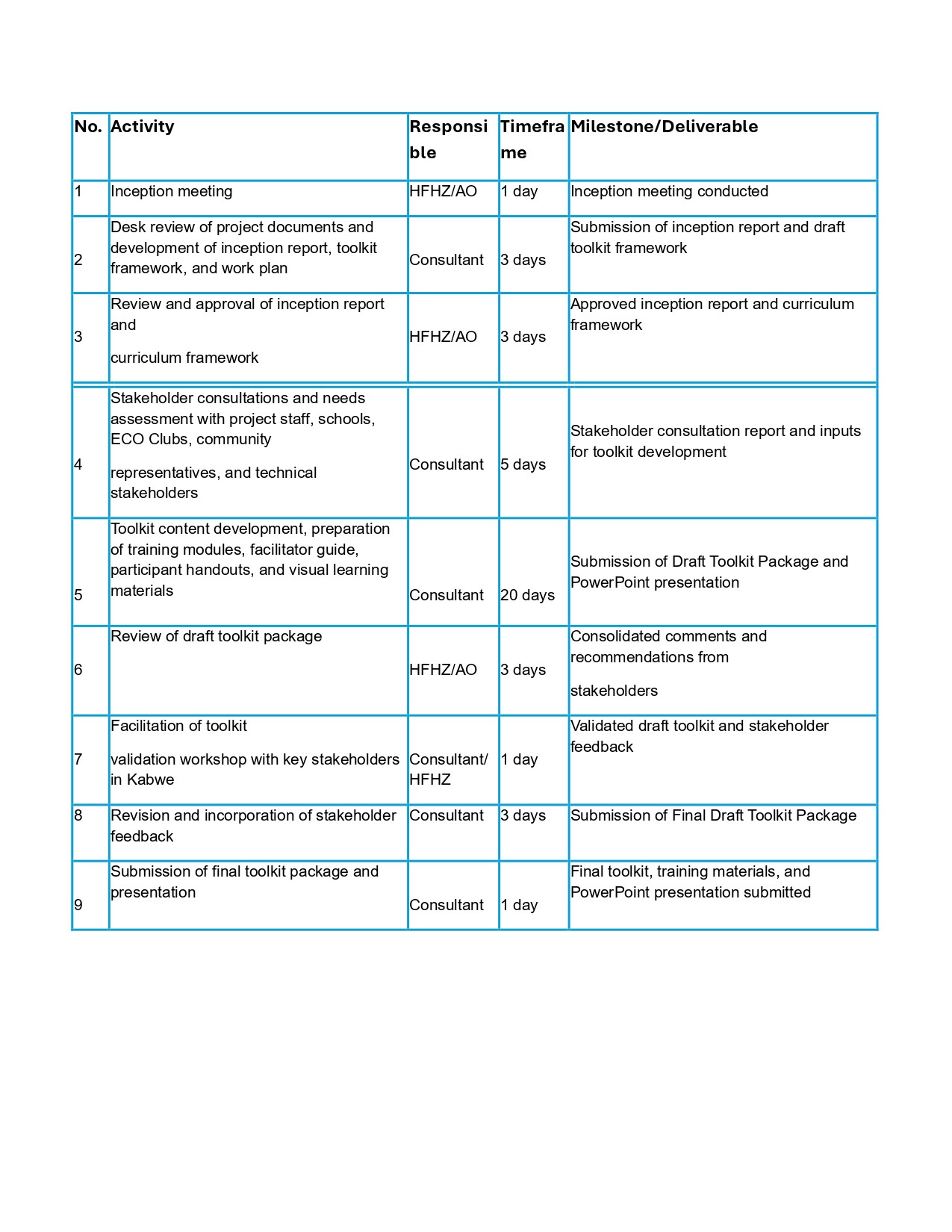
The assignment is expected to be completed within 40 days from the date of contract signing.
7. Duration and Timeline
The assignment is expected to be completed within 40 days from the date of contract signing.
8. Deliverables and Report Structure
A. Inception report, including toolkit development methodology, work plan, toolkit framework, and stakeholder consultation approach.
B. Draft toolkit package, including:
· Draft toolkit document
· Training modules and session plans
· Facilitator's guide
· Participant handouts and visual learning aids
C. Presentation of the draft toolkit and key content areas in report and PowerPoint format.
D. Toolkit validation workshop with HFHZ, relevant stakeholders, schools, and ECO Clubs.
E. Final toolkit package (including but not limited to):
I. Executive Summary
II. Introduction (background, rationale, objectives)
III. Toolkit Development Methodology
IV. Toolkit Framework and Learning Outcomes
V. Training Modules and Content Areas
VI. Facilitation and Learning Resources
VII. Implementation, Sustainability, and Scale-Up Recommendations
VIII. Annexes
▪ Final toolkit document
▪ Facilitator's guide and training materials
▪ Participant handouts and visual aids
▪ Validation workshop report and stakeholder feedback
▪ Final PowerPoint presentation incorporating agreed adjustments
9. Management and Coordination
The School Gardening Toolkit Consultancy will be managed by the Monitoring, Evaluation, Accountability and Learning (MEAL) Specialist with technical support from the Project Manager and overall supervision by the Programs Director. Coordination and update meetings will be held on a weekly basis to ensure adequate support to the process.
10. Ethical Standards and Intellectual Property
The consultant(s) shall ensure that the toolkit is designed and conducted in full respect of the rights, dignity, and welfare of all people and communities involved. The process must integrate safeguarding practices to protect vulnerable groups, particularly children and women, while upholding ethical standards of confidentiality and informed consent. The toolkit shall be technically accurate and reliable, conducted transparently and impartially, and aligned with Habitat for Humanity Zambia’s safeguarding and accountability commitments. Furthermore, the consultant(s) will ensure that findings contribute meaningfully to organizational learning, program improvement, and evidence-based advocacy.
All products, data, and outputs resulting from this evaluation shall remain the sole property of Habitat for Humanity Zambia and its project partners. Consultants are prohibited from presenting any analytical results as their own or using the evaluation findings for private publication, dissemination, or other purposes without prior written authorization from Habitat for Humanity Zambia.
11. Safeguarding
Habitat for Humanity Zambia requires all consultants to uphold the highest ethical standards and prioritize safeguarding in every aspect of their work. Consultants must actively contribute to creating and maintaining an environment that protects our beneficiaries, communities, and partners, especially children and other vulnerable groups from harm. This includes strict adherence to practices that prevent harassment, sexual exploitation, and abuse, as well as full compliance with Habitat for Humanity’s safeguarding policies and Code of Conduct. Habitat for Humanity Zambia holds a particular responsibility to strengthen and support systems that embed safeguarding into all operations, ensuring that dignity, safety, and respect remain central to our mission.
12. SUBMISSION DETAILS
12.1 Requirement profile
The contract will be awarded to a recognized and reputable company/individual with the following credentials:
• Independence from HFHZ and/or its Board of Directors. Any actual or potential conflict of interest must be fully declared at the time of application.
• The lead consultant and co-leads must hold an advanced degree in Education, Social Sciences, Agricultural Sciences, Environmental Sciences, or a closely related field. In addition, they should have demonstrated expertise in curriculum/toolkit development, adult learning, livelihood development, WASH, nutrition, and climate-resilient programming.
• The consultant/consultancy firm must demonstrate a minimum of seven (7) years of proven experience in curriculum/toolkit development, capacity building, training material development, and learning programme design for projects funded by institutional donors, with a specific focus on agriculture, food security, livelihoods, and community development within the Zambian context.
• The consultant/consultancy firm must demonstrate proven experience in developing participatory and learner-centered training curricula and facilitation materials for diverse audiences, including communities, schools, and local institutions.
• Experience of effective interaction with local and national organizations, government departments, educational institutions, and marginalized communities.
• Demonstrated experience in integrating cross-cutting themes such as gender, inclusion, nutrition, environmental sustainability, climate resilience, and behavioural change into training curricula.
• Good spoken and written communication skills in English and local languages.
12.2 Eligibility of the Consultant
Interested, eligible, and qualified consultants should submit:
- Electronic submission of the detailed technical and financial proposal inclusive of 15% Withholding Tax and a cover letter with a clear subject “School Gardening Toolkit Consultancy” outlining the methodology, approach, and expertise.
- Valid company registration certificate, company profile, and a valid tax clearance certificate.
- At least 3 samples of toolkits of similar nature.
- Names and contacts of 3 recent professional referees (previous clients) for whom similar work has been conducted.
- Names and CVs of individuals or team members proposed, highlighting their experience relevant to this study and their roles in the achievement of the assignment.
12.3 Financial Proposal
The budget for the consultancy should include a breakdown of all relevant costs, including professional fees and data collection logistics for local staff, including enumerators, local transport, accommodation etc. The budget should be presented for discussion with HFHZ. A detailed and easy-to-follow budget is expected with budget notes.
Tax and insurance: The consultant/s shall be responsible for their tax and insurance during the assignment.
13. Application and Deadline
Applications with eligibility documents outlined under 12.2 should be submitted electronically to
Procurement@habitatzam.org.zmaddressed to: Procurement Committee
Habitat for Humanity Zambia
P.O. BOX 3498
Plot 488a, Twin Palms Road, Kabulonga Lusaka, Zambia.
Office phone: (+260) 211 251087
The deadline for submissions is Tuesday 8th September 2026.